Samsung Galaxy S10 & S10+ Feature Infinity-O Display, On-Screen Fingerprint reader: Price & Specifications.
Tweet
 GALAXY S10 SPECIFICATIONS
6.1" QHD+ (3040×1440) Dynamic Amoled Infinity-O Display.
Qualcomm SD-885/Exynos 9820 processor.
Android 9.0 (Pie) & One UI.
12MP+12MP+16MP Back camera.
10MP Front camera.
8GB RAM.
128/512GB Internal Storage.
3,400mAh Battery Capacity.
Ultrasonic In-Screen fingerprint sensor.
Wireless PowerShare.
Price: $900.
GALAXY S10 PLUS SPECIFICATIONS
6.4" QHD+ (3040×1440) Dynamic AmoledI Infinity-ODisplay.
Android 9.0 (Pie) & One UI.
Qualcomm SD-885/Exynos 9820 processor.
12MP+12MP+16MP Back camera.
8MP+10MP Front camera.
8GB/12GB RAM.
128/512GB/1TB Internal Storage.
4,100mAh Battery Capacity.
Ultrasonic In-Screen fingerprint sensor.
Ceramic backing (option).
Wireless PowerShare.
Price: $1000.
Instead of two usual versions of the Galaxy S series, Samsung releases 3 versions of the flagship phone this year, and these are Samsung Galaxy S10, Galaxy S10 Plus, and the newly introduced, but cheaper, Galaxy S10E. However, this short review is about the 2 main Samsung Galaxy phones i.e. Galaxy S10 and Galaxy S10 Plus. More to come on S10E later.
The bigger Samsung Galaxy S10 Plus features 6.4-inch screen while the Galaxy S10 comes with 6.1-inch screen, and new phones displays feature the improved Dynamic Amoled Infinity-O Displays.
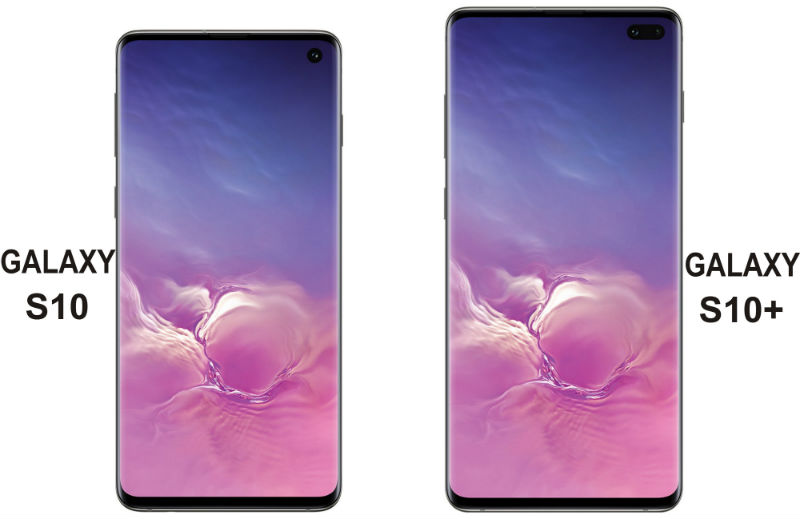
Also, while the Galaxy S10 features single lens front camera, the S10 Plus comes with a dual-lens front camera, and as usual, Samsung also compensate the bigger S10 Plus with more battery capacity.
Nevertheless, both phones come with the same processing power, same triple-lens back cameras and the same RAM and storage capacity, though, Samsung still offers the buyers with another variant of the Galaxy S10 Plus which has higher RAM, more storage capacity and ceramic backing.
 Improved Design
Although the S10 and S10 Plus still feature the same curved, edge-to-edge Infinity design of the earlier models, Samsung adopt 19:9 aspect ratio in the new phones and the top and bottom bezels have been removed also. In Other words, despite having the same traditional nearly edge-to-edge Infinity display of the Galaxy S9 and S9 Plus, the new Galaxy S10 and S10 Plus are slightly narrower and they have no top and bottom bezels.
However, instead of using notch (like other phone makers) to house the new Galaxy phones selfie cameras, the Samsung Mobile make use of the punch-holes (small cut-out holes) on the surface of the Amoled screens; which company now referred to as the Infinity-O display. The implementation of the punch-holes, located at right side of the displays, enables the new phones to gain more screen real estate and achieve 93.1% screen-to-body ratio, which is much higher than the 83% of the Galaxy S9 and S9 plus.
But the punch-hole of the Galaxy S10 screen is circle because the smaller phone has a single selfie camera, while the 6.4-inch of its big brother has a Pill-like punch-hole because the phone comes with a dual selfie camera, in fact, Galaxy S10 Plus is the first Samsung Galaxy phone to feature dual front camera set up.
Furthermore, instead of having dual back camera like their predecessors, the company also introduces triple rear cameras to each of the Galaxy S10 and S10 Plus; and the cameras are arranged in an horizontal manner on the back of the new phones. And because the Samsung Mobile introduces Ultrasonic In-display fingerprint sensor (more on it later) to the Galaxy S10 and Galaxy S10 Plus, there is no fingerprint reader on either the front or back of the new Galaxy phones.
Apart from the ones mentioned above, other physical aspects of the new phones remain the same as that of their predecessors. Therefore, on the left edge is the Bixby Button, while the phone's Hybrid SIM tray slot and speaker are located on the top edge. The Volume rocker and the Power Button are on the right edge, and on the bottom edge of the phone is the USB-C port, 3.5mm Audio Jack, microphone and Speaker.
Price, Colour and Weight:
Samsung Galaxy S10 and Galaxy S10 Plus Comes in colour of Prism White, Prism Black, Prism Blue and Flamingo Pink. But because Galaxy S10 Plus offers Ceramic Backing option, so there are also Ceramic White and Ceramic Black.
Bigger 6.1-inch and 6.4-inch Dynamic Amoled Infinity-O Displays:
Instead of the usual Super Amoled display, the new Galaxy S10 and Galaxy S10 Plus feature Dynamic Amoled Display, which delivers a more realistic and accurate colour than the Super Amoled display, In fact, the Samsung Dynamic Amoled screen is said to cover 100% of the DCI-P3 (Digital Movie Initiatives) colour space, as a result, Galaxy S10 Plus Displays are first phones Displays to be HDR10+ Certified.
Which means that, when it comes to displaying HDR10+ contents or videos, the new Samsung Galaxy S10 and Galaxy S10 Plus displays will offer more accurate colours and lifelike picture than other non-HDR10+ certified displays.
In addition, the Dynamic Amoled screen also comes with the Blue light filter; the feature that reduces the screen blue light that causes eye strain while using Smartphones.

Like their predecessors, Samsung Galaxy S10 and the Galaxy S10 Plus also feature QHD+ screen resolution, though, due to the adoption of the 19:9 aspect ratio, the QHD+ resolution has been slightly changed from the 2960x1440 to the 3040x1440 in the new phones.
In other words, Samsung Galaxy S10 and Galaxy S10 Plus have the same QHD+ (3040x1440) screen resolution.
However, due to its smaller screen size, Galaxy S10 has a slightly higher pixel density of 550PPI, but the Galaxy S10 Plus has a slightly lower pixel density of 522ppi.
Also, like in previous models, the display resolution of the new phones maxed at QHD+, but in order to preserve battery life, the out-of-the-box or default display resolution is still Full HD+ (2280×1080). In fact, the new phones' displays also supports lower HD+ resolution i.e. 1520×720.
Snapdragon 855, Android Pie and Samsung One UI: Depending on your region, the new Samsung Galaxy S10 and the Galaxy S10 Plus come with either Qualcomm Snapdragon 855 Octa-Core processor or Samsung own Exynos 9820 processor.
For those in the U.S and China, their Galaxy S10 and the Galaxy S10 Plus are powered by the Qualcomm Snapdragon 855 chipset, a 7nm Octa-Core processor with a maximum clock speed of 2.84GHz. And the Qualcomm SD chipset is also features Adreno 640 GPU.
And for those in the Europe and other regions, their Galaxy S10 and Galaxy S10 Plus are powered by the Samsung's Exynos 9820 CPU; 8nm processor with a maximum clock speed of 2.73GHz. Meanwhile, the Exynos 9820 chipset is fitted with the Mali-G76 MP12 GPU.
Meanwhile, along with the Android 9 (Pie) Operating System, Samsung Unveiled its own One UI, in the new Galaxy phones.
RAM and Storage
Samsung equipped the new Galaxy phones with more than enough ROMs and RAMs to store your large media files and to ensure the smooth running of the latest version of your favorite games and apps. Both Galaxy S10 and S10 Plus feature 8GB RAMs and internal storage capacity of either 128GB or 512GB. And as usual, both phones internal storage can be expanded, through MicroSD Card of up to 512GB.
Meanwhile, the premium version of the Galaxy S10 Plus comes with higher 12GB RAM and 1TB internal storage capacity. This means, including 512GB MicroSD Card, this premium version of the Galaxy S10 Plus presents the buyers with storage capacity of up to 1.5 TB.
Dual-Front camera for only Galaxy 10 Plus: Each of the Samsung Galaxy S10 and S10 Plus comes with a standard 10-megapixel front-facing camera, however in addition to its 10-megapixel front camera, Galaxy S10 Plus still has an extra 8-megapixel front camera, thereby making the Galaxy S10 Plus the first Samsung Galaxy phone to feature dual front-facing camera.
 Both features Triple Rear-Cameras: Moving on to the back of the new phones, each of them comes with horizontally arranged Triple-lens camera, in other words, apart from the dual-lens back camera which comprises of 12-megapixel Telephoto lens and 12-megapixels Wide-angle lens, each of the Samsung Galaxy still has another Ultra-Wide-angle 16-megapixels lens (in addition to the initial dual-lens), this 3rd lens assist the phone to take wider angle shots, or to capture more of what is in front of you without moving backwards.
Ultrasonic In-Screen Fingerprint Reader: In the new Galaxy 10, Samsung replaced the hitherto traditional visible fingerprint sensor with non-visible (in-display) fingerprint scanner. Samsung Mobile is not the first phone company to introduce In-display fingerprint reader, as Vivo (and few others) has implemented it in its Nex S and X20 Plus, however, with the aid of Qualcomm Snapdragon 885, Samsung is the first to introduce Ultrasonic in-display fingerprint sensor.
 This new Samsung Ultrasonic in-display fingerprint reader was reported to be, even, more secure than previous type of in-display fingerprint scanner. And, to unlock your new phone, all you need to do is place your finger (and exert slight pressure) on the screen surface of your new Samsung Galaxy S10.
Wireless Powershare: It's another new feature that is found on S10; Powershare allows you to "wirelessly" charge your Qi-enabled Samsung (even other brands) phones or devices with the new Galaxy S10, this is done by placing the Qi-enabled phones (or devices) on the back of the Samsung Galaxy S10.
 Note: Qi-enabled device is simply a device or phone that has wireless charging feature (can also be charged through wireless means), and they normally have glass backs.
Previous features are back, and they are better:
The Samsung's Voice Assistant, i.e. Bixby (and its button), is back again in the new Galaxy phones. Fortunately, and in response to people's demands, the Bixby button can now be remapped or reprogrammed to open another app.
Also, the Samsung AR Emoji App has also undergone refinement, compare to those of the last year's Samsung Galaxy S9, the Avatars now look more lifelike in the new Galaxy S10 and S10 Plus.
Furthermore, USB-C and 3.5mm audio jack are also found in the new Samsung Galaxy phones.
3,400mAh & 4,100mAh Battery.
As the new Galaxy S10 and S10 plus offer bigger displays and better specs than the last year's models, the new phones are also fitted with better battery capacity; while Samsung Galaxy S10 comes with 3400mAh battery, its big brother i.e. S10 Plus is fitted with 4100mAh Battery.
Although the new Galaxy phones come with high processing power and bigger displays which have effect on their battery lives, the Samsung Galaxy's Battery Saver optimizes their power usage, thereby extending the battery life of your new phone for day to day uses.
Tweet
6.1" QHD+ (3040×1440) Dynamic Amoled Infinity-O Display.
Qualcomm SD-885/Exynos 9820 processor.
Android 9.0 (Pie) & One UI.
12MP+12MP+16MP Back camera.
10MP Front camera.
8GB RAM.
128/512GB Internal Storage.
3,400mAh Battery Capacity.
Ultrasonic In-Screen fingerprint sensor.
Wireless PowerShare.
Price: $900.
GALAXY S10 PLUS SPECIFICATIONS
6.4" QHD+ (3040×1440) Dynamic AmoledI Infinity-ODisplay.
Android 9.0 (Pie) & One UI.
Qualcomm SD-885/Exynos 9820 processor.
12MP+12MP+16MP Back camera.
8MP+10MP Front camera.
8GB/12GB RAM.
128/512GB/1TB Internal Storage.
4,100mAh Battery Capacity.
Ultrasonic In-Screen fingerprint sensor.
Ceramic backing (option).
Wireless PowerShare.
Price: $1000.
Instead of two usual versions of the Galaxy S series, Samsung releases 3 versions of the flagship phone this year, and these are Samsung Galaxy S10, Galaxy S10 Plus, and the newly introduced, but cheaper, Galaxy S10E. However, this short review is about the 2 main Samsung Galaxy phones i.e. Galaxy S10 and Galaxy S10 Plus. More to come on S10E later.
The bigger Samsung Galaxy S10 Plus features 6.4-inch screen while the Galaxy S10 comes with 6.1-inch screen, and new phones displays feature the improved Dynamic Amoled Infinity-O Displays.
Also, while the Galaxy S10 features single lens front camera, the S10 Plus comes with a dual-lens front camera, and as usual, Samsung also compensate the bigger S10 Plus with more battery capacity.
Nevertheless, both phones come with the same processing power, same triple-lens back cameras and the same RAM and storage capacity, though, Samsung still offers the buyers with another variant of the Galaxy S10 Plus which has higher RAM, more storage capacity and ceramic backing.
Although the S10 and S10 Plus still feature the same curved, edge-to-edge Infinity design of the earlier models, Samsung adopt 19:9 aspect ratio in the new phones and the top and bottom bezels have been removed also. In Other words, despite having the same traditional nearly edge-to-edge Infinity display of the Galaxy S9 and S9 Plus, the new Galaxy S10 and S10 Plus are slightly narrower and they have no top and bottom bezels.
However, instead of using notch (like other phone makers) to house the new Galaxy phones selfie cameras, the Samsung Mobile make use of the punch-holes (small cut-out holes) on the surface of the Amoled screens; which company now referred to as the Infinity-O display. The implementation of the punch-holes, located at right side of the displays, enables the new phones to gain more screen real estate and achieve 93.1% screen-to-body ratio, which is much higher than the 83% of the Galaxy S9 and S9 plus.
But the punch-hole of the Galaxy S10 screen is circle because the smaller phone has a single selfie camera, while the 6.4-inch of its big brother has a Pill-like punch-hole because the phone comes with a dual selfie camera, in fact, Galaxy S10 Plus is the first Samsung Galaxy phone to feature dual front camera set up.
Furthermore, instead of having dual back camera like their predecessors, the company also introduces triple rear cameras to each of the Galaxy S10 and S10 Plus; and the cameras are arranged in an horizontal manner on the back of the new phones. And because the Samsung Mobile introduces Ultrasonic In-display fingerprint sensor (more on it later) to the Galaxy S10 and Galaxy S10 Plus, there is no fingerprint reader on either the front or back of the new Galaxy phones.
Apart from the ones mentioned above, other physical aspects of the new phones remain the same as that of their predecessors. Therefore, on the left edge is the Bixby Button, while the phone's Hybrid SIM tray slot and speaker are located on the top edge. The Volume rocker and the Power Button are on the right edge, and on the bottom edge of the phone is the USB-C port, 3.5mm Audio Jack, microphone and Speaker.
Price, Colour and Weight:
Despite their bigger sizes, the new Samsung Galaxy phones are lighter and flatter than their predecessors; because, while the Galaxy S10 Plus weigh 175g, Galaxy S10 has a weight of 157g.
It should be recalled that Galaxy S9 and S9 Plus weigh 173g and 189g respectively. Also, both new phones have less thickness of 7.8mm, compare to the 8.2mm and 8.3mm thickness of the Galaxy S9 and S9 plus.
Meanwhile, the current price of the Galaxy S10 is $900, but with additional $100, you'll get Samsung Galaxy S10 Plus, because the price of this bigger Galaxy phone is $1000. This also means that the price, $1000, of Galaxy S10 Plus is the same as that of iPhone XS i.e. the smaller brother of iPhone XS Max. The iPhone XS Max, on the other hand, is currently $1100.
Bigger 6.1-inch and 6.4-inch Dynamic Amoled Infinity-O Displays:
Instead of the usual Super Amoled display, the new Galaxy S10 and Galaxy S10 Plus feature Dynamic Amoled Display, which delivers a more realistic and accurate colour than the Super Amoled display, In fact, the Samsung Dynamic Amoled screen is said to cover 100% of the DCI-P3 (Digital Movie Initiatives) colour space, as a result, Galaxy S10 Plus Displays are first phones Displays to be HDR10+ Certified.
Which means that, when it comes to displaying HDR10+ contents or videos, the new Samsung Galaxy S10 and Galaxy S10 Plus displays will offer more accurate colours and lifelike picture than other non-HDR10+ certified displays.
In addition, the Dynamic Amoled screen also comes with the Blue light filter; the feature that reduces the screen blue light that causes eye strain while using Smartphones.
Like their predecessors, Samsung Galaxy S10 and the Galaxy S10 Plus also feature QHD+ screen resolution, though, due to the adoption of the 19:9 aspect ratio, the QHD+ resolution has been slightly changed from the 2960x1440 to the 3040x1440 in the new phones.
In other words, Samsung Galaxy S10 and Galaxy S10 Plus have the same QHD+ (3040x1440) screen resolution.
However, due to its smaller screen size, Galaxy S10 has a slightly higher pixel density of 550PPI, but the Galaxy S10 Plus has a slightly lower pixel density of 522ppi.
Also, like in previous models, the display resolution of the new phones maxed at QHD+, but in order to preserve battery life, the out-of-the-box or default display resolution is still Full HD+ (2280×1080). In fact, the new phones' displays also supports lower HD+ resolution i.e. 1520×720.
Snapdragon 855, Android Pie and Samsung One UI: Depending on your region, the new Samsung Galaxy S10 and the Galaxy S10 Plus come with either Qualcomm Snapdragon 855 Octa-Core processor or Samsung own Exynos 9820 processor.
For those in the U.S and China, their Galaxy S10 and the Galaxy S10 Plus are powered by the Qualcomm Snapdragon 855 chipset, a 7nm Octa-Core processor with a maximum clock speed of 2.84GHz. And the Qualcomm SD chipset is also features Adreno 640 GPU.
And for those in the Europe and other regions, their Galaxy S10 and Galaxy S10 Plus are powered by the Samsung's Exynos 9820 CPU; 8nm processor with a maximum clock speed of 2.73GHz. Meanwhile, the Exynos 9820 chipset is fitted with the Mali-G76 MP12 GPU.
Meanwhile, along with the Android 9 (Pie) Operating System, Samsung Unveiled its own One UI, in the new Galaxy phones.
RAM and Storage
Samsung equipped the new Galaxy phones with more than enough ROMs and RAMs to store your large media files and to ensure the smooth running of the latest version of your favorite games and apps. Both Galaxy S10 and S10 Plus feature 8GB RAMs and internal storage capacity of either 128GB or 512GB. And as usual, both phones internal storage can be expanded, through MicroSD Card of up to 512GB.
Meanwhile, the premium version of the Galaxy S10 Plus comes with higher 12GB RAM and 1TB internal storage capacity. This means, including 512GB MicroSD Card, this premium version of the Galaxy S10 Plus presents the buyers with storage capacity of up to 1.5 TB.
Dual-Front camera for only Galaxy 10 Plus: Each of the Samsung Galaxy S10 and S10 Plus comes with a standard 10-megapixel front-facing camera, however in addition to its 10-megapixel front camera, Galaxy S10 Plus still has an extra 8-megapixel front camera, thereby making the Galaxy S10 Plus the first Samsung Galaxy phone to feature dual front-facing camera.
Ultrasonic In-Screen Fingerprint Reader: In the new Galaxy 10, Samsung replaced the hitherto traditional visible fingerprint sensor with non-visible (in-display) fingerprint scanner. Samsung Mobile is not the first phone company to introduce In-display fingerprint reader, as Vivo (and few others) has implemented it in its Nex S and X20 Plus, however, with the aid of Qualcomm Snapdragon 885, Samsung is the first to introduce Ultrasonic in-display fingerprint sensor.
Wireless Powershare: It's another new feature that is found on S10; Powershare allows you to "wirelessly" charge your Qi-enabled Samsung (even other brands) phones or devices with the new Galaxy S10, this is done by placing the Qi-enabled phones (or devices) on the back of the Samsung Galaxy S10.
Previous features are back, and they are better:
The Samsung's Voice Assistant, i.e. Bixby (and its button), is back again in the new Galaxy phones. Fortunately, and in response to people's demands, the Bixby button can now be remapped or reprogrammed to open another app.
Also, the Samsung AR Emoji App has also undergone refinement, compare to those of the last year's Samsung Galaxy S9, the Avatars now look more lifelike in the new Galaxy S10 and S10 Plus.
Furthermore, USB-C and 3.5mm audio jack are also found in the new Samsung Galaxy phones.
3,400mAh & 4,100mAh Battery.
As the new Galaxy S10 and S10 plus offer bigger displays and better specs than the last year's models, the new phones are also fitted with better battery capacity; while Samsung Galaxy S10 comes with 3400mAh battery, its big brother i.e. S10 Plus is fitted with 4100mAh Battery.
Although the new Galaxy phones come with high processing power and bigger displays which have effect on their battery lives, the Samsung Galaxy's Battery Saver optimizes their power usage, thereby extending the battery life of your new phone for day to day uses.
Tweet



Comments
Post a Comment